
Recently, Professor Jiang Lin and Associate Professor Peng Meiwen from the Institute of Functional Nano and Soft Materials (FUNSOM), together with Professor Sun Yinghui from the College of Chemistry, Chemical Engineering and Materials Science at Soochow University, published their findings in Nature Energy.
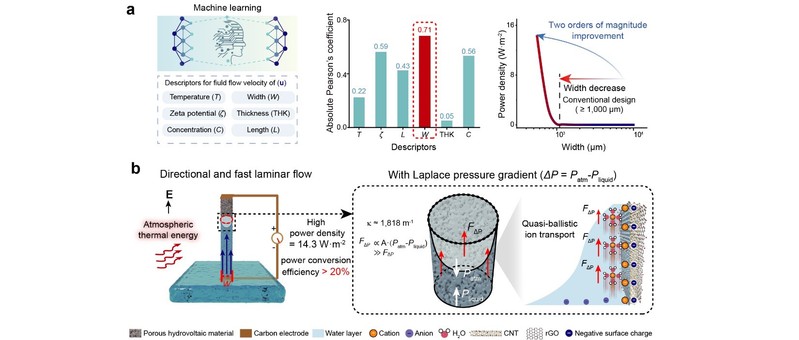
In conventional planar thin-film and bulk-structured devices, fluid flow is generally chaotic and sluggish, resulting in consistently low power density and energy conversion efficiency. To address this challenge, the team proposed a machine-learning-guided structural optimization strategy, and designed and fabricated a vertical microrod generator (VMG), realizing quasi-ballistic ion transport and efficient evaporation-driven power generation in a liquid-phase system for the first time.
This strategy establishes a comprehensive theoretical framework for quasi-ballistic ion transport, offering important theoretical and technical guidance for the efficient harvesting of low-grade atmospheric thermal energy and the development of next-generation ambient energy harvesters.
Access the paper online at:
https://www.nature.com/articles/s41560-026-02117-3
