
Recently, a team co-led by Professor Zhong Zhiyuan and Professor Deng Chao at Soochow University published a research paper in Nature Sustainability.
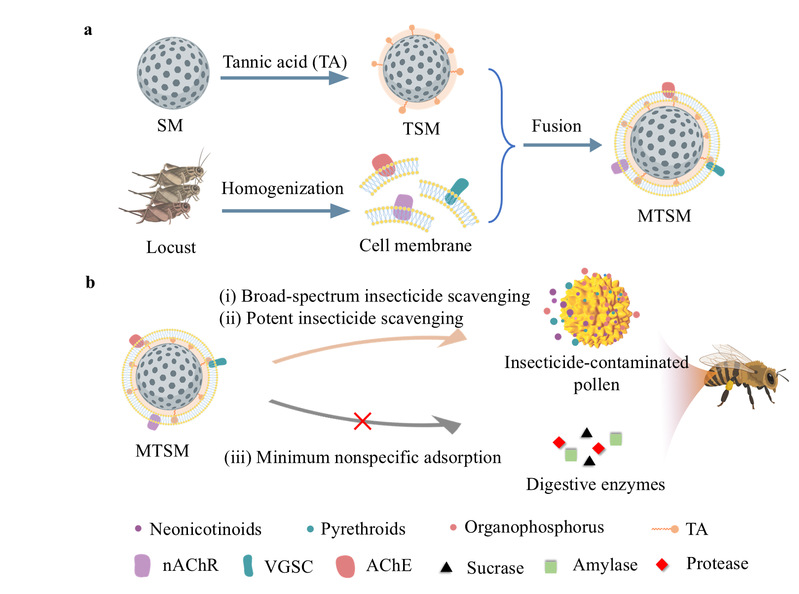
Pollinators contribute to approximately 75% of global food crop production, yet insecticide exposure caused a persistent sharp decline in their populations. The study proposed a dual mechanism combining physical adsorption with membrane-protein-mediated specific recognition and degradation: the researchers grafted natural tannic acid onto mesoporous silica microparticles and coated them with locust cell membranes, developing biomimetic microspheres (MTSMs) capable of both capturing a broad spectrum of insecticides and safeguarding bee health. The biomimetic detoxifying microspheres were made from naturally degradable raw materials, with a simple and highly scalable fabrication process. They can be mixed directly into sugar syrup for feeding, compatible with existing beekeeping practices, and offer a new solution for pollinator protection in green and sustainable agriculture.
Access the paper online at:
https://www.nature.com/articles/s41893-026-01867-y
